Inhaltsverzeichnis
Q-Sort
The Q-Sort technique is a tool within the broader Q-methodology (Q methodology), a research method that lies at the intersection of quantitative and qualitative research. It is primarily used to capture structures of opinions, attitudes, and values. The aim is to capture individual opinions at a more complex level in order to subsequently construct types of subjective perspectives and identify their similarities and differences.
To do this, a set of items (the Q-sample) is first generated, which respondents then rate relative to one another and sort into a predetermined ranking scheme. Typically, Q-Sort uses a pyramid-shaped ranking scheme in which most items are classified into the neutral middle category, while the categories become progressively smaller toward the extremes. It is therefore a forced-choice procedure in which respondents can only assign a certain number of items to each category due to the shape of the ordering scheme.
Method Procedure
Step 1: Pre-sort cards (optional)
Sort into, for example: disagree, neutral, agree (labels are customizable) This option is particularly useful for large numbers of items or Q-sets to avoid overwhelming the respondent(s).
Step 2: Place cards into the grid/sorting scheme
Step 3: Reorder cards (optional)
Ask the respondent via a text box whether they are certain about the order.
Step 4: Comments on outlier cards (optional)
Option to explain the choice of outliers in an open text field.
Steps 1, 3, and 4 can be enabled or disabled under Optional Function.
Settings
Detailed settings can be found in the Additional Settings tab.
Instructions
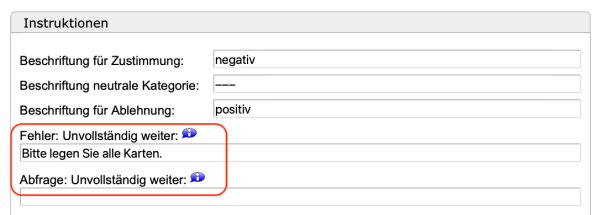
Here, labels and instruction texts can be customized.
The “Error: Continue if incomplete” and “Query: Continue if incomplete” fields allow you to specify whether all items must be sorted. If the “Query” field contains a message, the respondent may proceed to the next question without having to sort all items. If the “Error” field contains a message, the respondent must place all items.
Grid
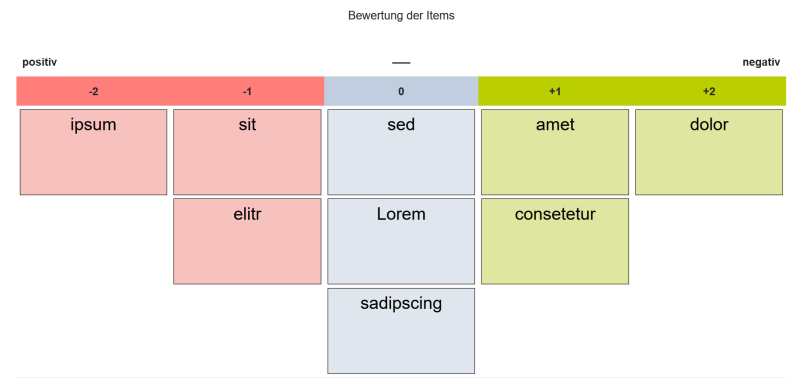
This setting determines the structure and alignment of the sorting scheme. The classic Q-sort technique distributes category sizes like a normal distribution curve, with a large neutral category and small extreme categories.
Example 1 of a grid (alignment: top-aligned, nine items)
Design
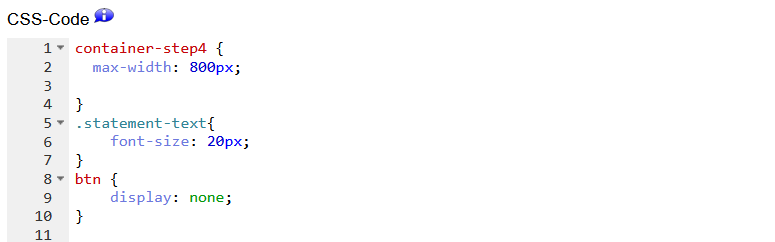
Here you can change the color scheme of the grid/sorting scheme. More advanced customizations can be made using CSS code. The item cards can be accessed via the “statement” class (see image below):
Items (Statements)
The statements are entered in the Items section.
The respondent always sees only the item currently being sorted. The order can be set in the Items section. The item at the very top of the list is displayed last, and vice versa.
References
Further information on Q-methodology (German/English): Q-Sort Technique and Q-Methodology
Analysis
There are various types of analysis in the Q-method, with rotation procedures being the most common.
- A good overview of the advantages and disadvantages of various analysis methods is provided by: Akhtar-Danesh (2017).
- A comparison of the analysis methods (centroid factors with judgmental rotation and principal components with Varimax) and tools (KADE, Pgmethod) is provided on the page KADE.
As with all multivariate analysis methods, the following applies regardless of the method chosen: What matters is whether the statistically generated categories can also be interpreted in terms of content—and thus, ultimately, in qualitative terms—and described with sufficient precision.
Application Examples
Pfeiffer, Sabine (2024): AI as a Colleague (KIK) – Representative Employee Survey on Artificial Intelligence in the Workplace. In: Heinlein, Michael; Huchler, Norbert (eds.): Artificial Intelligence, Humans, and Society: Social Dynamics and Societal Consequences of a Technological Innovation, pp. 15–40. Wiesbaden: Springer Fachmedien. https://doi.org/10.1007/978-3-658-43521-9_2
Pfeiffer, Sabine (2024): AI as a Colleague: A Representative Employee Survey on Artificial Intelligence in the German Workplace, in: Heinlein, Michael; Huchler, Norbert (eds.), Artificial Intelligence in Society: Social, Political, and Cultural Implications of a Technological Innovation, Wiesbaden, pp. 353–379. https://doi.org/10.1007/978-3-658-45708-2_14